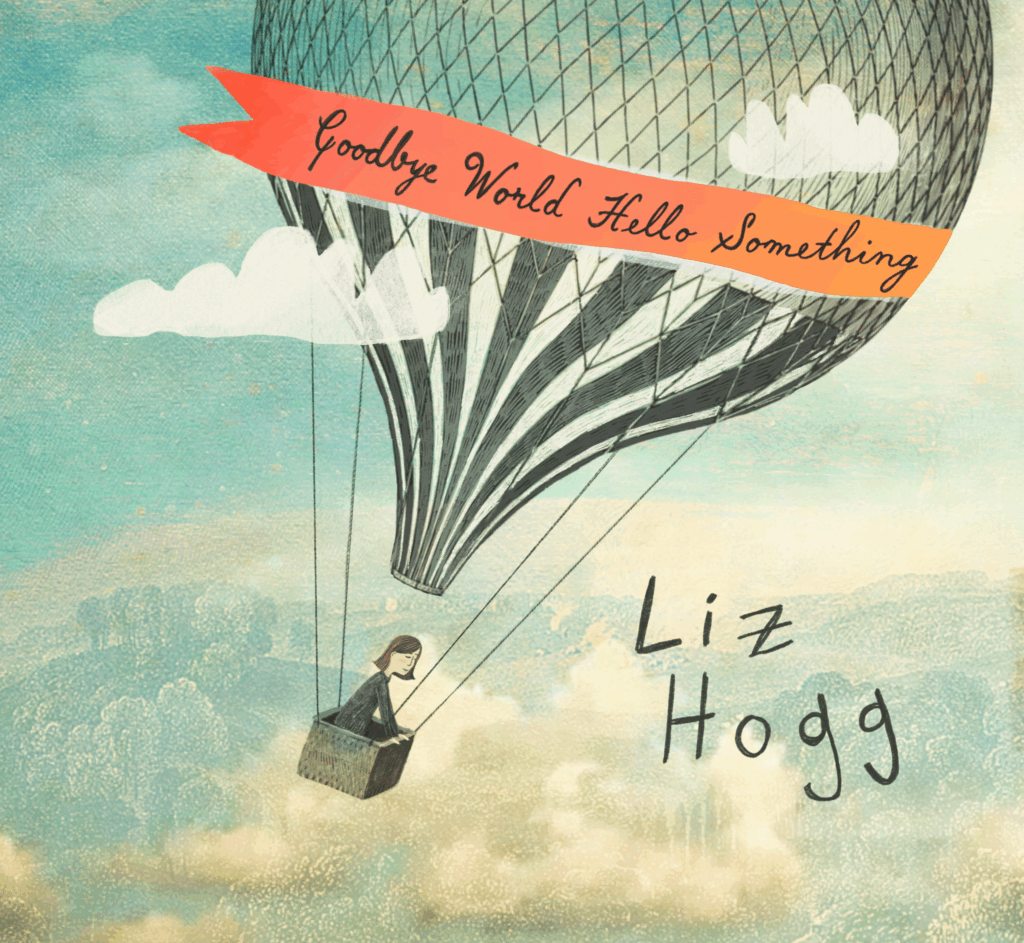
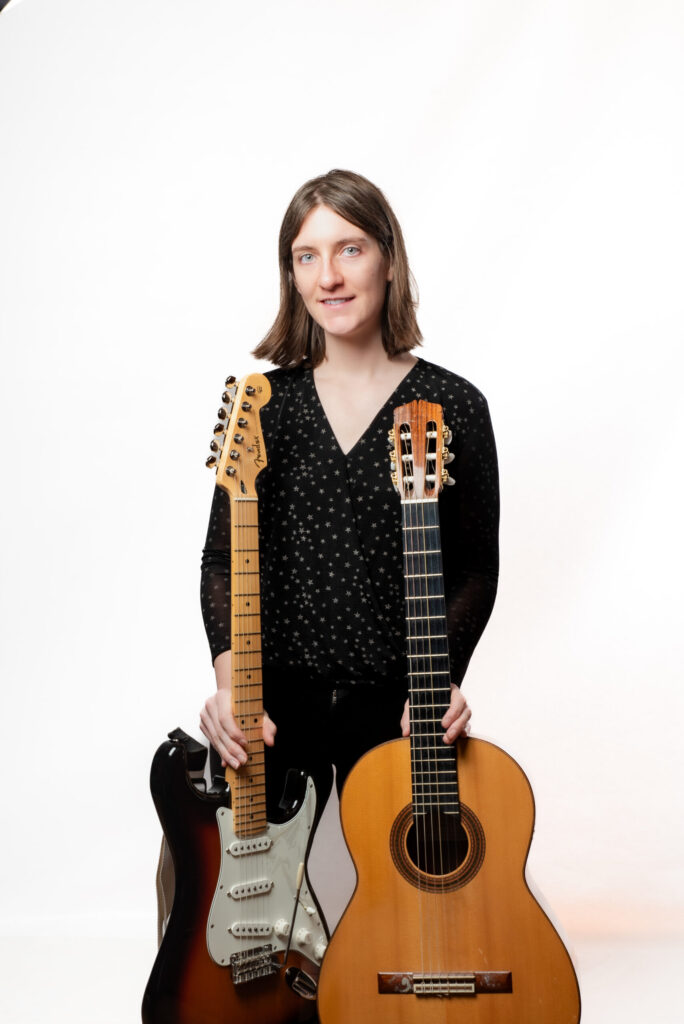
Alt-rocker and guitar virtuoso Liz Hogg returns with her sophomore album Goodbye World Hello Something, a meticulously crafted yet effortlessly inviting collection of songs that balance wit, warmth, and existential curiosity. Written over just 20 days under a strict set of self-imposed rules, the album showcases Hogg’s refined songwriting instincts and adventurous spirit, drawing from indie-pop textures, classic influences, and deeply personal moments.
Goodbye World Hello Something was written under a very strict set of rules. What first pushed you to impose that kind of structure on your songwriting for this album?
It’s always more fun to play within boundaries, so you know you’re playing. Without a clearly defined structure, there is nothing to bounce against or bang off of. I wanted to create one of those playpens that kids are in where they can bounce up and down and hit the wall but not get hurt. If that box wasn’t there and they just jumped freely, that would be quite dangerous and probably deadly. But with a secure box, you have room to really go crazy. I also did it so that I would maintain a level of detachment from the music that I felt would help me see it and judge it more clearly. I wanted to write music that other people besides me would like. I didn’t want myself to get in the way of the music. I also wanted to maintain a level of cohesion, uniformity, flow and inner album connectedness I felt I hadn’t been as successful with in other releases. Having all tracks adhere to some common rules helps build that cohesion. Eliminating as many choices as possible gave me a strong box to play in so to speak without sacrificing the big picture.
You wrote the entire record in just 20 days using what you call “kernels.” Can you walk us through how those 283 snippets became the 10 songs that made the final cut?
It was a randomized process so I wouldn’t pick favorites and leave all the trickier or less appealing ones to the end of the work pile, leaving my work cut out for me in future albums. I wanted to level the playing field. So I divided each of the kernels into 7 groups based on instrumentation and recording methods (Acoustic Digital, Acoustic Tape, Distorted, Electric Clean, Electronic, Sped-up Tape, Voice). I then proceeded alphabetically just to be practical with Acoustic Digital, going with the first 10 that appeared. 2 of the kernels were extremely similar, the ones that generated tracks 9 & 10. I chose to have all 10 come from the same folder so that there would be some kind of homogeneity from the get-go, being that the origin of each song was conceived on an acoustic guitar and recorded digitally; due to this, most of these kernels were recorded on my phone during practice session breaks from 2020-21.
One of your rules was that each song had to be written in one or two sessions so a “purer message” could come through. How did that approach change the way you normally write?
In the past, I wrote more in a linear fashion. For this album, I decided on the form first – I called it the coloring book method. I would focus on the form and the drums for the longest time, then settle on the message/overarching feeling of the song and the vocal melody. Lastly, via expanding upon and harmonizing the kernel, the basic chord progressions and other melodic ideas were generated. This came from singing along and quickly jotting down all the various things I heard in the kernel. I felt that 2 songwriting sessions would limit the variety of output and number of ideas in a positive, constructive way. I often told myself: “write songs that believe in themselves.” Which, to me meant, basically fulfilling all the possibilities of one small idea, and not tempering it or “backing it up” with other ideas, almost as a backup plan – just keeping it as focused and to the point as possible. At the same time, not “simple,” just making sure all the many parts, if there are many, are all just offshoots from a very limited, usually just one or two, basic motives. I think it’s much harder to achieve this if you let a song go, and come back to it in a week, when your mood and frame of mind could be completely different; the song can run the risk of becoming hackneyed or stilted. Some genres of music and even some pop/rock songs could benefit from a longer more drawn out process, but not these songs I had in mind, which were supposed to be more to the point and guttural.
The album feels breezy and lived-in, yet the lyrics balance playfulness with existential weight. Were you consciously trying to strike that balance, or did it emerge naturally?
It was something I did consciously but it was also unconscious because it’s just become a part of my personality: playfulness with existential weight. No matter how serious a subject or how dark I might feel about any kind of emotional situation that inevitably comes up, I always end up laughing about it too, even when I don’t think it’s appropriate sometimes. But I think it’s a good thing. The older I get, the funnier I find situations I might have previously taken very seriously. It could also relate to how I grew up – perhaps a lot of people who grew up in NYC have that attitude. It’s a dramatic, heavy, serious place but is also full of funny situations. The old adage that humor is tragedy plus time is true indeed.
The opener, “Things I Said Before,” was inspired by a meditative bike ride from the East Village to Queens. How important are physical movement and environment to your creative process?
I think that the experiences I accumulated in my first 18 years of life are enough to carry me through several albums. That being said, like anyone, the more I see, feel and experience, the better my creative process and the more material to draw from. The most important thing for me to be artistically productive is to feel organized and secure. To do that, I need space and time. I couldn’t achieve that until I was close to 30, but that’s when I got serious about hunkering down and getting into the mental space to write another album. Most of the feelings and lessons from life happen very young I think, and getting older is not about new experiences as much as it is about reaping the benefits of more perspective and wisdom to clearly articulate and learn from those visceral experiences that shaped your core. (But maybe I’m wrong and a lot more will happen that I’ll experience on a visceral level which would be nice). So, a lot of the rush and initial creative bursts that I recorded as kernels were written when I was pretty young. Though a few more did bubble to the surface after 2023 when I archived them all. So a fun part of writing the album was accessing the youthful exuberance that met the energy I wanted and pairing that with what I have now: a more analytical and fully formed brain to refine that initial little life burst into something fully formed.
“Wonder When” features Strokes-like guitar interplay and two false endings. What drew you to playing with structure and repetition on that track?
I think the idea behind the song encouraged me to do the false starts and repetition – the narrator wondering when things are going to happen and take off for them. The song often chugs along, analogous to the train of life we find ourselves on, often thinking “alright this is my stop,” but turns out there’s a breakdown and total delay. That’s just life.
“On Paper” leans into themes of longing and permanence. What does the idea of something being “real enough to put on paper” mean to you personally?
On a societal level, it’s indicated by culture that one leads a righteous or moral life if everything that defines them on paper actually aligns with their inner feelings and values. What could be considered integrity. Looking at history, real life situations, and all types of books/movies, we see how often that is not the case. So the song is about making the fight for actually getting what you want and consummating your goals and life decisions on paper. Literally, that is: birth records, property, marriage records, contracts, etc. – anything you can hold up and touch and feel as the paper physical form of something that is usually abstract. On a personal level, for me that’s everything that can be put down on paper.
Belly” stands out as one of the record’s most playful and humorous moments. How do you decide when humor belongs in a song without undercutting its emotional weight?
I think it works in middle album tracks best. And I think anything flirty or sexy should be funny. And definitely if I’m singing it, because I wouldn’t trust myself at this point in time to deliver it otherwise. I think you can succeed by not undercutting its emotional weight by presenting the funny cute side as one section and the more serious side as another, as if they are 2 different characters communicating. The chorus of “Belly” is the sad, disappointed, weighty part, (even though the lyrics could be construed as nonsensical, it’s a truthful metaphor) and the verse is “cute, funny, flirty, silly”. But choruses always win, so silliness should not trump, unless it’s one of those joke songs which I’m not interested in doing at the moment, and that seems to be a little bid of a fad from the past but certain Kinks songs and other usually British bands of that era succeeded there.

“Master & Commander” feels like the emotional centerpiece of the album and deals with miscommunication and heartbreak. Why do you think that song continues to resonate so strongly, even for you?
Thanks! The ending was completely improvised and done all the way through in one take. I then learned it and recorded it pretty much one beat at a time (since it never followed any repetitive enough pattern) in the studio. I think the ending illustrates the resignation and final death throes of the shipwreck, ie heartbreak, whatever it is. And I think the overall starkness of the track, with a lot of rhythmic spacing and clarity of the parts makes it more poignant. So the instrumentation, orchestration and long, lonely, a little meandering and almost aimless outro are for me what makes it resonate. Maybe it resonates because heartbreak is the most real aspect of love – it’s the part that lasts forever, not the love part. I didn’t think of it at the time but I may have been channeling one of my favorite songs, “Love Hurts” by the Everly Brothers. Their resignation and the wariness they subtly convey in the singing matched the heaviness I wanted to imbue into the song.
The record shows off your guitar work, especially on tracks like “Curl.” How did your background as a classical guitarist shape the sound and arrangements on this album?
For this album, most of the kernels happened to be recorded between 2020-21 when I’d take a break or zone out for a minute during a classical practice session, so they pretty much all were played in original form on the classical guitar – which resulted in parts that involved non adjacent strings and a focus on timbre and resonance of certain chord voicings that are a little more apparent on classical and nylon guitars than electric. When I actually got down to writing the songs, I was much more pop and rock focused, drawing on forms and concepts in those spheres, but a concept of drawing out all ideas from a single particle was championed by Beethoven and I can’t help but use all the theory and general musical knowledge I’ve acquired throughout years in school and studying on my own later, consciously or not.
You’ve cited John Lennon’s songwriting ethos and the organic feel of Ram as influences. What aspects of The Beatles’ legacy were most important to you while making this record?
The immediateness and directness of their songs, especially in their early years. If the entire history of the world were written up to today, I really feel that the thrusting of the Beatles upon the world achieve the apex, the climax of this allegorical novel of the history of the world, when spring comes and the main characters fall in love, and all the important events and feelings bubble to the surface in one big explosion. Also, that sense of youth, urgency and just writing amazing songs that could hold up being strummed on one acoustic guitar and sung by an adequate singer. I wanted to write songs whose skeletons were strong enough to stand on their own and did not rely on any gimmicks, effects, or even another layer beyond maybe a single riff and chord progression to succeed. All that is great but a rule of mine was that the song should still function well without it, and virtually every single Beatles song can do that. The sweetness, naivety and brashness of their early years always warms my heart and doesn’t cease to make me very emotional. It wasn’t until 2019, despite listening to them all throughout my childhood, that they become very engrained and I knew I had to put some of that influence to use; by then my 1st album was written so it ended up showing itself more on this one.
After living with these songs and hearing people respond to them, what do you hope listeners ultimately take away from Goodbye World Hello Something?
I hope it’s an album they’ll listen to forever! I keep about 6,000 carefully selected songs on my iPhone at all times, and the glorious shuffle is the soundtrack to my life. I’ve meticulously crafted and have continuously updated the list since I was around 14. For all the people out there who listen to music in a similar fashion in their day to day, I would be honored if my entire album ended up on that permanent shuffle. And for anyone else, to accompany it on days that span years throughout their life.
___________________
With Goodbye World Hello Something, Liz Hogg proves that creative constraints can unlock surprising freedom, resulting in songs that linger long after they end. Whether it’s the emotional pull of “Master & Commander” or the playful charm threaded throughout the record, the album feels intimate, thoughtful, and quietly addictive—an inviting world listeners won’t want to leave once they’ve stepped inside.