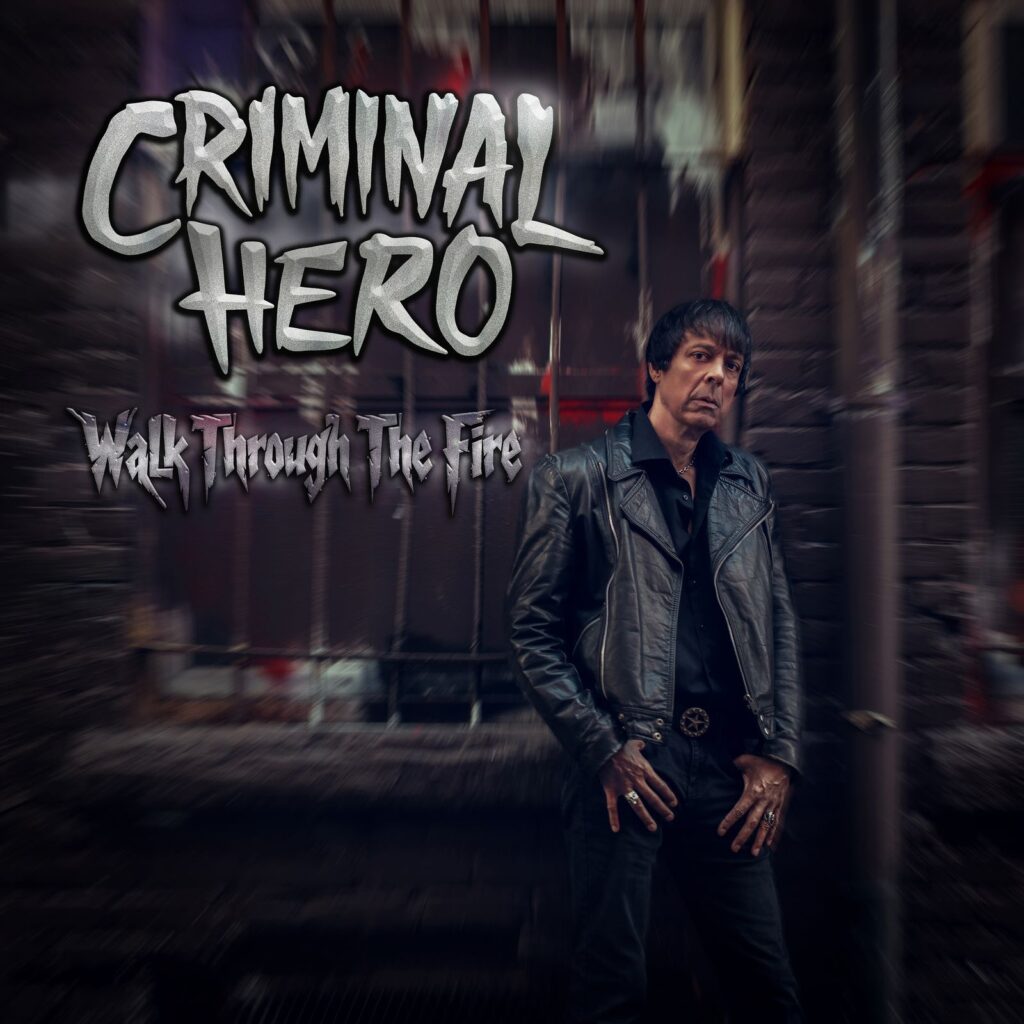
Criminal Hero releases its debut album, Walk Through the Fire, today (Friday, August 28), delivering big guitars, driving rhythms and undeniable hooks with a punk-fuelled edge. Led by songwriter and guitarist Rick Harkness, the project was born in Toronto, shaped in Detroit, and is now based in Vancouver.
The project’s connection to Detroit’s legendary rock lineage has already caught the attention of SPIN Magazine, which described Criminal Hero as “a refreshing blast of pure Detroit-powered punk rock from Canada in the spirit of The Stooges and the MC5.”
“Do You Wanna Go,” the album’s focus track and lead radio single, captures Criminal Hero at its most immediate: a swaggering, confrontational rock song driven by attitude, tension and the moment when talking is over and a line has finally been drawn.
INTERVIEW
The name Criminal Hero immediately suggests two sides of the same person. What does that name mean to you, and how does that play out throughout the album?
The name Criminal Hero came from the idea that people are rarely just one or the other. You can be the hero in one person’s story and the villain in someone else’s, and sometimes you can be both at different points in your life. Much of it depends on perspective.
You see it everywhere, in politics, business, and music. Rock ’n’ roll has always been full of rebels; what makes someone undesirable in one person’s eyes can make them a hero in another’s.
That idea runs through Walk Through the Fire. In “She’s to Blame,” the protagonist places the blame squarely on someone else while admitting he remains drawn to her. “Do You Wanna Go” depicts two people locked in conflict, each trying to decide who is right and whether the relationship is worth saving. “Bring It On” moves toward taking control, walking away, and emerging on the other side. In these songs, nobody is entirely innocent or entirely guilty. It depends on who’s telling the story.
You describe Walk Through the Fire as an album written across several different chapters of your life. When you hear these songs together now, what story do you feel they tell about the person you were then versus the person you are today?
The ten songs came together quickly, over about six to eight months, but they drew on experiences and observations from my life. By then, I had already been through a lot: stepping away from music, living in different countries, starting over after a divorce, moving between Toronto, Detroit, and Vancouver, and eventually returning to music.
I wasn’t trying to make a big autobiographical statement. I was simply following whatever interested me at the time, whether it was relationships, people, things I saw around me.
Listening to the album now, with some distance, I can see connections I wasn’t necessarily aware of at the time. There’s a lot about conflict, winning and losing, getting knocked around a little, and finding your way through all of it.
I feel like I’m in a much better place now, and finding my way back to music may have had something to do with that. Looking back, I wonder if part of why I struggled at times was because I had left such an important part of myself behind. Coming back to it has felt healing.
Criminal Hero was born in Toronto, shaped in Detroit, and is now based in Vancouver. How has each of those cities left its mark on you creatively, and particularly on the sound of this record?
Toronto is where my musical education began. I was born and raised there. The ’70s and ’80s influences that found their way into Criminal Hero trace back to those years.
Detroit was different. That’s where the idea of Criminal Hero began to take shape and where Walk Through the Fire was written and recorded. I lived in the city proper and became deeply connected to local venues, bands, and musicians. I was also surrounded by neighborhoods still scarred by decades of industrial decline, so I experienced the city’s rebound and toughness firsthand. Detroit has an incredibly strong musical identity, but what connected with me most was its rawness. It wasn’t polished or concerned with following someone else’s rules, and that essence, mixed with Toronto’s history, bled into the writing. I truly love Detroit. There was always something about the city that felt strangely familiar to me, maybe because of its proximity to Toronto or because of the rock and punk history the two cities shared.
Toronto gave me my musical education. Detroit is where those influences started turning into something of my own. Vancouver gave me enough distance to look back and realize it was time to master the tracks, commit to the sound, and put it out there.
If you could go back and play Walk Through the Fire for your 20-year-old self, which song do you think he’d love the most, and which one would surprise him?
My 20-year-old self would probably connect with “Do You Wanna Go.” It has that high-energy rock ’n’ roll groove that gets right in your face. It’s a confrontation mixed with exhaustion. It’s about someone who won’t commit, the games that come with it, and finally asking for the truth or for the other person to leave.
“I Can Feel You” might surprise him. It’s more personal than some of the other songs, dealing with physical chemistry, sexual confidence, and emotional surrender, and with giving in to desire even when you know it might be reckless. It’s also my favorite solo on the record, and I think he’d be okay with that.
If someone had never heard Criminal Hero before and you could only play them one song from the album, which one would you choose and why?
I’d probably choose “You Better Believe”. It was the first song I wrote for Criminal Hero. There’s an old saying that you had years to write your first song; it was already in you, waiting to come out. I’d been away from playing music for many years, and once that song arrived, everything else followed.
It’s also more autobiographical: two people meet at a show, fall in love, and eventually start a family. It isn’t a literal retelling of my life. I didn’t consciously set out to write that, but the emotional starting point is real. I also think the story is universal. Many people can relate to it.
Musically, it’s a good representation of the album. It has some of the punk edge and energy that runs through Criminal Hero, but it’s a positive song. Not all of them are. A lot of the others are more cynical, confrontational, and opinionated, which is probably a little more like me. And because it was the first song, it still feels like the place where Criminal Hero began.
If Criminal Hero could open for any band, past or present, who would you want to share a stage with?
The late ’70s version of Cheap Trick. They’ve always had that blend of melodic rock, big pop choruses, and a quirky look. They didn’t take themselves too seriously and put on a great live show. To me, that’s the whole rock ‘n’ roll package. You’re not just playing the songs; you also have a memorable, intriguing image. I think Criminal Hero would fit naturally on that bill.
With Walk Through the Fire introducing Criminal Hero to a much wider audience, what would you like to see happen next for the project?
Walk Through the Fire feels more like an opening statement than a conclusion. I want to take those core ideas further, with more stories and even more attitude. I want to keep writing and keep refining both the sound and the visuals.
I’ve always gravitated toward ’70s rock bands. To me, it was rock’s greatest era, and I don’t think we’ll ever see anything quite like it again. The artists had real individuality. You could hear a few bars or see a photo and immediately know who it was. That era is part of my musical DNA, and I want to stay true to it. I’m not interested in following trends.
Rock spent a lot of years out of the spotlight, but you can hear it coming back. I want to bring some of that look, attitude, and individuality to people who weren’t there for it, while pushing the sound forward. I’m excited for people to experience Criminal Hero from the beginning. Those who are there from the start can come along for the full ride.
What’s the best piece of advice another musician has ever given you, and did you follow it?
“The rock’s easy, but the roll is another thing.” Keith Richards
I’ve always believed you’re only as good as your drummer. Charlie Watts had that undeniable, swinging heartbeat, and without him, the music would have sounded very different.
I followed that advice without really trying, because those influences are already in me; I just needed to channel them properly. When I picked up the guitar and started writing again, I had a lifetime of music to draw on. I love many genres, but I knew my roots were in rock. When I started writing Walk Through the Fire, I knew it had to have that groove.
For me, the power of rock ’n’ roll is that it makes people move, lifts them up, and makes them feel good.
And finally – have you ever met any of your musical heroes? If so, who? And what were the circumstances around that meeting?
Growing up in Toronto in the ’80s, I spent a lot of time around the bars on Queen Street West and Spadina Avenue, particularly the El Mocambo and Grossman’s Tavern. The El Mocambo hosted a jam night where anyone could get onstage, and it was the ultimate hangout for musicians. The house band included Tony “Wild T” Springer, Matt Innes of The Jitters, Malcolm Tomlinson, who had played with Elton John and Jethro Tull, and Ian Cameron of Strange Advance.
One night, a guy stumbled toward the stage. You never knew who was going to get up there, and sometimes it was just a drunk guy, so expectations weren’t exactly high. He sat down, laid the guitar flat across his lap, and I was only half-paying attention. Then the band kicked in, and my jaw dropped. He was ripping through incredible solos, fretting the guitar in a completely unconventional way. I knew immediately I was in the room with greatness.
That guy was Jeff Healey. He was a regular at Grossman’s, and after that I started taking everyone I knew there to see him. I talked to him on and off when he wasn’t playing. This was before he became a huge international artist performing in small rooms. That experience taught me the value of embracing who you are and not sounding like someone else. He was a true inspiration on more than one level.