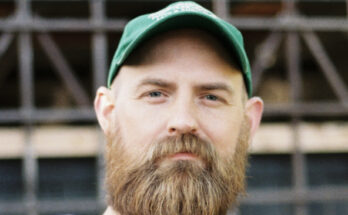
Rags Rosenberg creates music that makes one think, while the instrumentation – in all of its Americana glory – wraps his words in a cloak of gravitas and grit. Tales of climate change and the treatment of military veterans, interspersed with an ode to a late-night hangout called “Smokey Joe’s,” populate his new album, “Song of the Bricoleur.” It’s resplendent with smart musicianship and even smarter lyrics. Rosenberg paints pictures with his words, building images for the mind’s eye with his descriptions, just as the namesake bricoleur builds things from the damaged bits and bobs of life, the detritus, perhaps making something even more amazing in the process. Rosenberg has, in taking inspiration from all of the broken things in the world and in society, bricoleur’ed one of the best albums of the year. We sat down with him recently to get the lowdown on this stellar collection of songs.
Hi, Rags! You have a terrific new album out in September called “Song of the Bricoleur.” How did these songs come together and what broad strokes can you tell us about the collection?
Thanks for the kind words! Everything in this project revolves around the title song, “Song of the Bricoleur,”which is my response to this historical moment in which a fundamental change in society appears to be taking place. I’m talking about the digitization of our lives, AI, the dissolution of the civil society we have lived in for several hundred years. I started the song in 2011, so it’s been through quite a journey to get to your ears. In 2023, I got serious about recording and selected most of the other songs and the poem, “The Code,” for the project, because they seemed to address various aspects of what it means to live in these times. I would describe most of the album as folk-noir. Because it’s image-driven and employs a lot of archetypal characters, I call it “Mythopoetic Folk.”
One of the songs on your new album, “John Doe,” is really great and stood out to me. What can you tell us about that song? What inspired you to record this song?
No matter how each of us feels about the never-ending wars we are fighting, there’s one thing I think we can all agree on: the manner in which we welcome back and reintegrate those whom we’ve sent into the trauma of war says a lot about the nature of our country. What that says about America frightens and appalls me. Assoon as it came to me that the story could be told in first person by a nameless veteran lying in the morgue, I got to work.
I’d been performing “John Doe” in my live shows for a while, but knew it wasn’t done. I played the song for Gretchen Peters, who suggested I could take it deeper, that I might want to explore why having a name is important. I added a second “B” section and a new last verse, and everything clicked into place with the line,“They’ll know my name where I’m headed now.”

What was it like recording this album? What was the vibe in the studio overall, and how did this song, in particular, come together?
I recorded all the guitar/vocal work tapes and did all the preproduction in my home studio. That solitary vibe agrees with me. We tracked the musicians at Jesse DeCarlo’s studio in Monterey. The vibe was always chill. I was continually awed by how those players brought the songs to life. It was clear to me that they personally connected with the content of the songs and gave them the best they had to offer. The pedal steel/dobro player, Charlie Joe Wallace, now joins me for my shows.
In January, I went back to my old haunts in Joshua Tree to track with some old friends and had them all gather in Pat Kearn’s Goat Mountain Recording for the rousing outro chorus of “California Bound” and recorded the final vocals using a U87 at Richard Bryant’s room. Jesse DeCarlo did all the mixes, and Pete Lyman in Nashville mastered.
You asked about “John Doe” in particular, and that was a special case. I wanted the production of that song to have broad appeal, maybe find some ears beyond the world of folk music, so I sent the work tape to a producer I’d worked with when I still lived in Nashville. I never would have come up with that tremolo-drenched baritone guitar! Jesse mixed it here in Monterey with the rest of the tracks.
What do you hope this album conveys to those who listen to it?
In his poem, “Motto,” Bertold Brecht said: “In the dark times / will there also be singing? / Yes, there will also be singing. / About the dark times.”
First and foremost I want to convey the notion that in times of great uncertainty, we have agency. We can imagine a better world into existence. Neither a pessimistic nor an optimistic outlook is inherently more valid or truthful than the other when it comes to predicting or interpreting life’s events or the future. The darker songs on the album, like “Ticket to the Game,” should be heard as cautionary tales, not predictions. The message in “Song of the Bricoleur” is the line, “We’ll make it up as we go.” I think that perfectly encapsulates our era.
The album title is interesting. How did you choose it? What does it mean to you?
Bricoleur is a French term referring to a handyman or a tinker, but my use of it here is more expansive. Think of a bricoleur as an ordinary person like you or me who uses what they have on hand to fix or replace what is broken or no longer useful. And there’s a lot broken right now.
This current transformation we’re witnessing has been going on for quite a while. When the common people of France decided to end kingship by divine right and invent a new form of government, they were bricoleurs. That, and the enlightenment, changed everything. Today, it’s the digitization of our lives, AI, and the recurrent rise of fascism, and we will navigate those challenges as we always have, with creativity and intention, as bricoleurs, “making it up as we go.”
If you look back over your career, you probably feel like quite a different performer now than when you began for a number of reasons – life experience, industry experience, studio and performing experience all factoring into that. Where do you tend to get your biggest inspiration from these days?
You are absolutely correct. When I moved to Nashville in 1994, I wanted to make a living writing songs others would perform. But I failed at that. I was unable to write believable country songs, because I lacked the background, the talent, and the interest. Everything changed in 2008 when I moved to Joshua Tree. During the 14 years I lived in that isolated, 450-square-foot cabin, I went back to my first loves – Leonard Cohen, Bob Dylan, Tom Waits – and wrote most of the songs on this project.
My inspiration always comes when I hear some new, heartfelt, exquisitely crafted song. It makes me want to create something with that power, that ability to move people. That’s the practice I continue to hone.
Songwriting and recording music can be a really personal endeavor, yet when you release a song or an album, you share the music with so many people. How does this make you feel, and is it difficult to share songs widely like that? Have you gotten feedback from anyone who has connected with your music or had a song impact them in a deep and meaningful way?
For me, the writing would be pointless if it weren’t shared, and this recording is what allows the songs on “Song of the Bricoleur” to bloom. I could not be more proud of what we created and, as a result, I have no difficulty sharing it widely.
When I used to perform my song, “I’ll Meet You There,” people often asked where they could find the song. But I had not yet recorded it. I eventually recorded it on my first album, “Flower Time,” but, until then, I’d go home and record it on my iPhone and send it to them. It’s a song I wrote for my estranged sister about reconciliation, and it seemed a lot of people connected with that.
After my recent CD release party, one of my fans came up and told us she was the oldest of three sisters, and none of them had spoken in years. The song inspired her to contact them, and they’re talking again now.
The first time I performed “John Doe,” it got a standing ovation. I’ll not soon forget that moment. People were clearly impacted.
One last thought – I love watching people’s faces light up when they make the connections in “Smokey Joe’s.”
What has been the most exciting thing to happen for you in the past year? What are you most looking forward to for the rest of 2025?
I’ve never had the resources or the self-confidence to put together a team. The most exciting thing to happen in the past year has been that I’ve hired Kari Estrin to promote to radio and Krista Mettler for publicity, and they’re making it happen in a way I never could have. Being a musician, recording and promoting your work is a commitment with a steep learning curve. I’ve always been an autodidact and never graduated from college. “Song of the Bricoleur” is my PhD.
What I’m most looking forward to in 2025 is discovering how people are impacted by the songs on the album.
Got any tour plans? Where can fans see you on the road?
I lived and toured in my 16’ Scamp trailer all during the year before covid. I don’t currently have a tour schedule worked out, but I play a lot of house concerts, and I’m likely to pick up and go anywhere when invited! You can always see where I’m playing at ragsrosenberg.com.