Stephanie Braganza has spent years exploring what her voice can do. She has performed jazz standards, tackled Iron Maiden’s “Run to the Hills” and studied the choices that make singers as different as Ella Fitzgerald, Michael Jackson and Björk immediately recognizable.
When she recorded “The Child Inside,” however, her attention was on the memories behind the words. The softer phrases, small trembles and moments of greater intensity emerged as she sang.
“Rather than trying to make the performance sound emotional, I was simply allowing myself to feel what I was singing.”
Released October 22, 2026, the single reflects a growing priority for the Mississauga artist: having a personal connection to the stories she tells. In her answers to Notes From The Crowd, Braganza speaks candidly about the encouragement that kept her making music, the exhaustion of running a working band and the creative freedom she now values.
A voice shaped by curiosity
Braganza has always been drawn to extraordinary singers. Whitney Houston’s power and control, Fitzgerald’s agility, and the ranges of Freddie Mercury and Steve Perry all offered something to learn from.
Michael Jackson’s evolution particularly interests her. She points to the emotional delivery of “Who’s Lovin’ You” when he was a child, then to “Wanna Be Startin’ Somethin’,” where his voice becomes almost another percussion instrument.
Technical ability is part of the attraction. Equally compelling are the decisions that give a performance its character. Björk’s Homogenic, with its unconventional approach to music and singing, occupies its own place among her influences.
“I’d say those influences have shaped my voice more than the actual music I write,” she explains.
Her relationship with her own sound has taken work. People have often suggested she would make a good Disney singer, which amuses her because she has not always liked the natural brightness of her voice. She has spent years developing a bigger, fuller sound.
That curiosity has also led her into unexpected repertoire. An Iron Maiden album might not be one she would reach for at home, but performing “Run to the Hills” offered an irresistible vocal challenge.
“Those ridiculously high notes toward the end were a challenge, and that was part of the fun!”
Gratitude for an unexpected beginning
Looking back at her debut album, Unexpected, brings mixed feelings.
Braganza hears herself in the vocal melodies, almost all of which she wrote. Many of the lyrical concepts came from her producer at the time, leaving some distance between the songs and the person she has become.
There are still tracks she enjoys performing. The title song, inspired by quantum entanglement, approaches love through an unusual concept that continues to interest her. The album’s name also captured the surprise of releasing a record at all.
“At that point in my life, I think a lot of people would’ve been surprised to see me release an album,” she says. “To be fair, I was one of them!”
She had seriously considered giving up music. Her producer believed in her potential before she could fully see it herself and became the driving force behind completing the album.
Braganza can hear choices she would make differently now while remaining grateful for the record and the encouragement that made it possible.
“Without his encouragement and everything he put into making it happen, I’m not sure I’d be doing what I’m doing today.”
What has changed most is her sense of what she wants to express. Songs including “Chains of Silence,” “Feel A Little Less,” “Until We Meet Again” and “The Child Inside” carry a connection she increasingly needs from her work.
“I want to believe in what I’m singing and have a genuine connection to the stories I’m telling.”
Knowing what to leave behind
Her understanding of creative independence also comes from years of managing a band.
Shortly after graduating, Braganza started a Top 40 group. Responsibilities were initially shared with her partner at the time, but eventually much of the management fell to her. She booked shows, negotiated fees and coordinated musicians.
The work revealed what she could handle, although it did not always make her more confident in her decisions. Managing personalities, pursuing bookings and trying to move beyond the bar circuit gradually diminished the pleasure of performing.
After seven years, stepping away brought both disappointment and relief.
“It helped me recognize the difference between what I’m capable of doing and what I actually want to pursue.”
These days, she would rather put that energy into the music itself.
The memories inside the song
Braganza rarely chooses a genre before she begins writing. The story helps determine the musical direction.
With “The Child Inside,” she was addressing the pain of being hurt by a parent, a form of heartbreak she feels receives less attention than romantic loss. She wanted the arrangement to carry the vulnerability of the lyrics.
The song began with a few chords that moved her and a melody developed around them. Guitarist Steve John Dale then built the acoustic arrangement. Braganza describes an innocence in his opening playing and a passage near the end that resembles a child’s music box.
They kept the instrumentation minimal: guitar, vocals and harmonies.
“I wanted something that was stripped bare, much like how I was baring my heart in this song.”
The cover artwork brings that connection to childhood into view. It features Poppsy, the stuffed dog she has kept since she was little. In her earlier Modern Mississauga interview, Braganza described him as a source of comfort during times when she did not feel safe.
Among the photographs she shared for this feature is an image of herself as a baby with Poppsy. Beside the single artwork, it gives a quiet sense of how long this companion has been part of her life.
During recording, Braganza concentrated on the meaning of each line. Certain memories naturally brought more weight to her delivery. She allowed those changes to remain part of the performance.
The little dog behind the music
Another deeply personal song, “Until We Meet Again,” remembers her late dog Pom-Pom.
Her experience teaching voice and piano has shaped her understanding of dynamics, including when a song calls for more power and when to pull back. Braganza draws on that understanding in the song’s vocal arrangement to express grief’s changing intensity. The first chorus is gentle. Later, stronger drums and layered call-and-response vocals allow the feeling to build.
“Sometimes grief is quiet and reflective, and other times it’s almost impossible to contain,” she says.
The animated lyric video preserves the everyday details of their life together. Much of it was based on footage she had taken of Pom-Pom: pulling socks from her feet to play keep-away, or travelling with her to work on Toronto transit.
Those memories let viewers meet his personality alongside the song’s account of loss.
“Creating the video also felt a little like putting together a scrapbook.”
The process gave her a reason to revisit their shared life. The video closes with a dedication to Pom-Pom, the other animals she has loved and lost, and anyone who has experienced the heartache of saying goodbye.
Until We Meet Again — Official Lyric Video:

Bringing the stories into the room
What should someone expect from a Stephanie Braganza performance?
“Expect some powerful vocals, plenty of emotion and probably a little awkwardness between songs!”
She spent much of her life trying to hide that awkwardness. Now she is learning to embrace it. Sharing the experiences behind her originals can be difficult, particularly in front of strangers, but the possibility of connection makes it worthwhile.
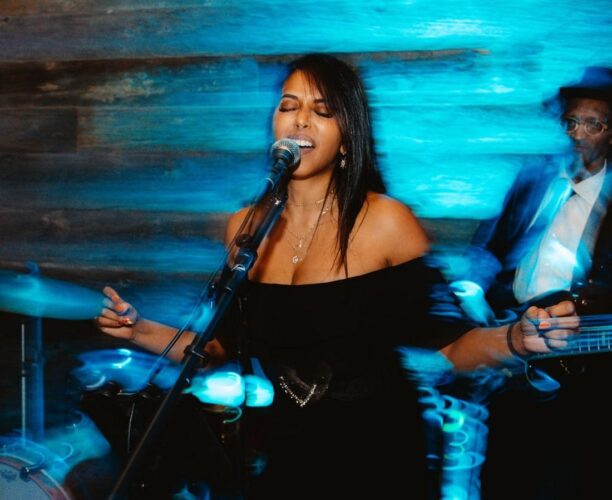
With a full band, she becomes more animated, responding to the musicians around her and the feeling of having a team behind her. A duo changes the arrangements while still leaving room for power and energy.
She remembers performing “Chains of Silence” at a folk festival with a guitarist and explaining why she wrote it. Although animal rights can be divisive, she felt the song reached people who might not share her views.
Braganza is partway through recording another song and remains conscious of finding different ways to express herself with each release.
She would also welcome the chance to appear on another artist’s recording. Having previously collaborated with Drega on her own music, she is curious about experiencing that exchange from the other side.
“I’d be interested to see what another songwriter hears in my voice and what they might challenge me to do with it.”
There are still aspects of her voice for which she has not found the right material. That leaves something to look forward to: a song she has yet to write, or one another musician might invite her to sing.