Americana singer-songwriter Jonathan Paull Gertler has a keen eye for emotional detail, and his lyrics have always demonstrated this fact so clearly. His latest album, released in October and entitled “Unfinished Business,” is a pandemic album, one that, while dealing with difficult topics and serving as a reminder of a very uneasy and challenging time, serves up a healthy dose of hope and resilience and understanding. We made it out the other side, and we shouldn’t forget the lessons we learned about ourselves and the world in the process. Gertler’s songs ache and soothe, a satisfying push-pull listening experience full of emotion and meaning. Add this to the “great albums of 2026” list. We sat down with him recently to talk about “Unfinished Business” in wonderful detail.
Hi Jonathan. Thanks for chatting with us today. You have a terrific new album out in October called “Unfinished Business.” How did these songs come together and what broad strokes can you tell us about the collection? You can give us the nutshell version or the long version – it’s up to you!
First of all, thanks for your kind words about the album. I really appreciate it. Writing and recording “Unfinished Business” has been a wonderful experience start to finish. Great musicians, great producer, and a chance to just learn things about music and myself over and over again. The songs were born out of the pandemic – certainly the loss but also my inevitable optimism with inspiration from the empathy, concern, and care I saw all around me. I started with “Reckless Heart” in a newish style for me – an intentional move on my part away from a lot of the jazz chord formations that I had always applied to my writing even when rooted in folk. Somehow that song formed the basis for the rest of the album. “Unfinished Business” came next, written right after the news came that John Prine died in an ICU. I didn’t listen to him often, but he was in the fabric of any Americana songwriter’s sensibility. Our lives were in disarray day to day but my circle – many of whom were people in the medical field or at least scientifically and socially tuned in – maintained values that were strong and resilient despite massive challenges – “The grass grows strong and wild” in the second verse. All the final versions of the songs took a couple of years and reflected all we faced and how we changed and how the important things should never change.
One of the songs on your new album, “One Heart Beating,” is really great and stood out to me. What can you tell us about that song? What inspired you to record it? What is the story behind it?
Wow, I am so pleased to hear that one stood out to you. It is a deeply personal tune for me. It was initially inspired by a very dear older friend – my mentor during my academic vascular surgical career – who became a Buddhist during the pandemic. He was a wonderful and somewhat flawed man (we all are, but he had some particular demons) with a probing mind, a great intellect, and the peace he found was through that change and embrace. The song coupled the Buddhist “one hand clapping” sensibility to seeing some friends and family hit truly rough patches during the isolation we all had and how hard it was to help – “one heart beating” – and the lyrics and music came together. The chorus, though, is fun for me. I had written a song in college (somewhere back in the late 19th century) that I always loved melodically but the lyrics were immature and the song hit the shelf a long time ago. The chords and melody of the chorus fit “One Heart Beating” to a T, so years later that progression and melody got resurrected – with some minor adjustments and all new lyrics, of course. Nice to always put things to use! This song has one of my favorite lyrics I’ve ever written – “Let simple grace undo where I have failed.” That pretty much says it all.
What was it like recording this album? What was the vibe overall, and how did this song, in particular, come together with the people you worked with in the studio?
Rock Ridge Music put out my second album, “No Fear,” and as part of that relationship, they asked me to record in Nashville the next time around. And thus came Paul Ebersold, who works closely with them as a producer. What a gift. Paul – who is not only a wonderful guy – is encyclopedic about music genres, has incredible instincts, and was just a constant fount of learning to work with. And the assembled musicians – I have to call out Kai Welch, Josh Hunt, and Jimbo Hart (and thank you, Matt Menefee, for terrific dobro and banjo at separate sessions) – were kind and inspiring guides though the process. I felt they were happy to be recording stuff that I hope is a little different both lyrically and musically than a lot of Nashville fare. Paul and I went back and forth on our respective sensibilities – he throws stuff at the canvas and subtracts, and I did not understand his process at first as I was going for greater simplicity. But he was so respectful and thoughtful and at the end – as Kai Welch put it – pulled it beautifully “out of the ether.”
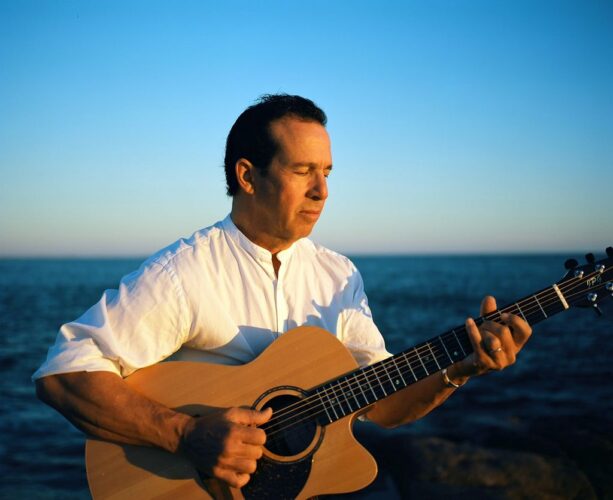
For “One Heart Beating,” it’s a complex guitar part behind the vocals, but when recording it was necessary to make sure all the other players had the full sound. As with all the tracks during the sessions, I played both my parts simultaneously but did so with a mic rather than a separate input for my acoustic so vocals and guitar bled together. When all was recorded, I had to go back and do the guitar and the vocals separately. I thought at first the emotions would come out better when I was singing and playing together but being able to sing over the full instrumental tracks gave me more freedom that I thought I would have.
Speaking of recording, how did you settle on a “feel” or “sound” for “One Heart Beating”? Did it end up sounding like you imagined, or did it take a different path in the studio?
“One Heart Beating” was done pretty much at first as it ended up, but there was more electric and instrumental layering when we first recorded. Paul and I ended up layering primarily acoustic counterpoints, and Josh’s subtle backbeats made it the way we both wanted it. And the chorus needed a little back-up harmony. Not present on most of the tracks, but needed here.
I try to write a mix of styles and Paul brought them to life. I wanted acoustic fingerstyle to come through each time, but then you go from “Quarantined,” with a slide that screams, to “Lifeline,” which is a very fingerpicking-forward song. I am happiest when there is a range of traditions. The only tune that deviated from the style I had envisioned was “Best of Times.” I had written that one over a Christmas break, and two of my sons – one a jazz pianist and the other a string bass player – and I played it together as it was getting finalized with a little too much wine on board. To me, it was out of the classic American songbook – a Louis and Ella vibe (which is the way I played it at the last gig I did), but it ended up more western swing under Paul. His way works, of course – it always does. The mix of sounds on the album from scorching slide to percussive banjo to plain fingerpicking is just the type of eclecticism I like.
What was the most difficult part of putting the album together? What was the easiest?
The hardest part was making sure I enjoyed myself and didn’t get intimidated by those great and seasoned players and recording 14 hours a day. And I did. So much fun. Thankfully, I had a chance to re-do vocals, as my voice sounded like I had swallowed steel wool and had a 50% reduction in range by the end of each day.
The best part was sitting in the engineer’s booth and all of us talking about each take all together and going back out and doing it again. What a dream.
Your music has a real depth to it, lyrically, that speaks to life experiences. How do you think the many chapters in your life have factored into your music? What things did your past teach you that you’ve been able to apply to songwriting and music making?
Thank you for saying that. That means more to me as a comment on the music I write than anything else that could be said. All writing is personal, and all writing is observational. Nothing is autobiographical, and everything is autobiographical. So, a lifetime of living – which inevitably includes risk, loss, love, fear, joy etc. – if it doesn’t give you subject matter, you’re not paying attention. I can’t make up emotions for the sake of a song, though I can make up storylines to express the ones I have. And I work hard to make sure the lyrics are unpredictable.
One tune of Jason’s Isbell’s off of the album “Foxes in the Snow” (which is an album I could listen to 10 times a day) sticks out to me. In “Eileen” he writes: “My own behavior was a shock to me / I never thought I’d have the nerve / I hope you’re sleeping through the night, Eileen / I hope they’re grading on the curve.” “Grading on the curve” is the last line I expected, and it is perfect. I keep hoping I can always pull off something even close to that.
What do you hope this album conveys to those who listen to it?
Resilience. Hope. And the absolute necessity that we had better understand that we are saved most by empathy and kindness to each other, and it’s time we get started again on that as our approach to the world and each other.
The album title… how did you choose it? What does it mean to you? What do you feel is “Unfinished Business” in your own life?
I leaned toward either “Overwhelmed” or “Unfinished Business.” “Overwhelmed” is a song I love for a host of reasons related to the hopes and fears of a couple of dear friends who were going through truly trying times. At the end of the day, though, “Unfinished Business” is what it all is: We keep striving, we should never be complacent, and there is always something we can do better. And I don’t say this out of negativity. I say it because if we always aspire for more, we can at least get closer to it. I had a song on the album “No Fear” called “Grasp the Moon.” Same idea. Inspired by Louis Sullivan, one of the great civil rights leaders and exemplary physicians and educators that I know, who used the phrase – “Shoot for the stars and you can grasp the moon.” We are all still unfinished, even when we are through.
Where do you tend to get your biggest inspiration from these days?
All the people who are working so hard to make this a better world despite so many people who are not. And those around me – friends and family I love – who make a life a life.
Do you have any plans to tour or play any live shows? Any other new music in the works?
I’ve completed five songs I like (and a few I don’t that won’t see the light of day) for the next album. Would love to do a quiet gig sometime if time allows. Maybe just me, a bass, another voice. That would be fun.